Maison & Jardin Magazine
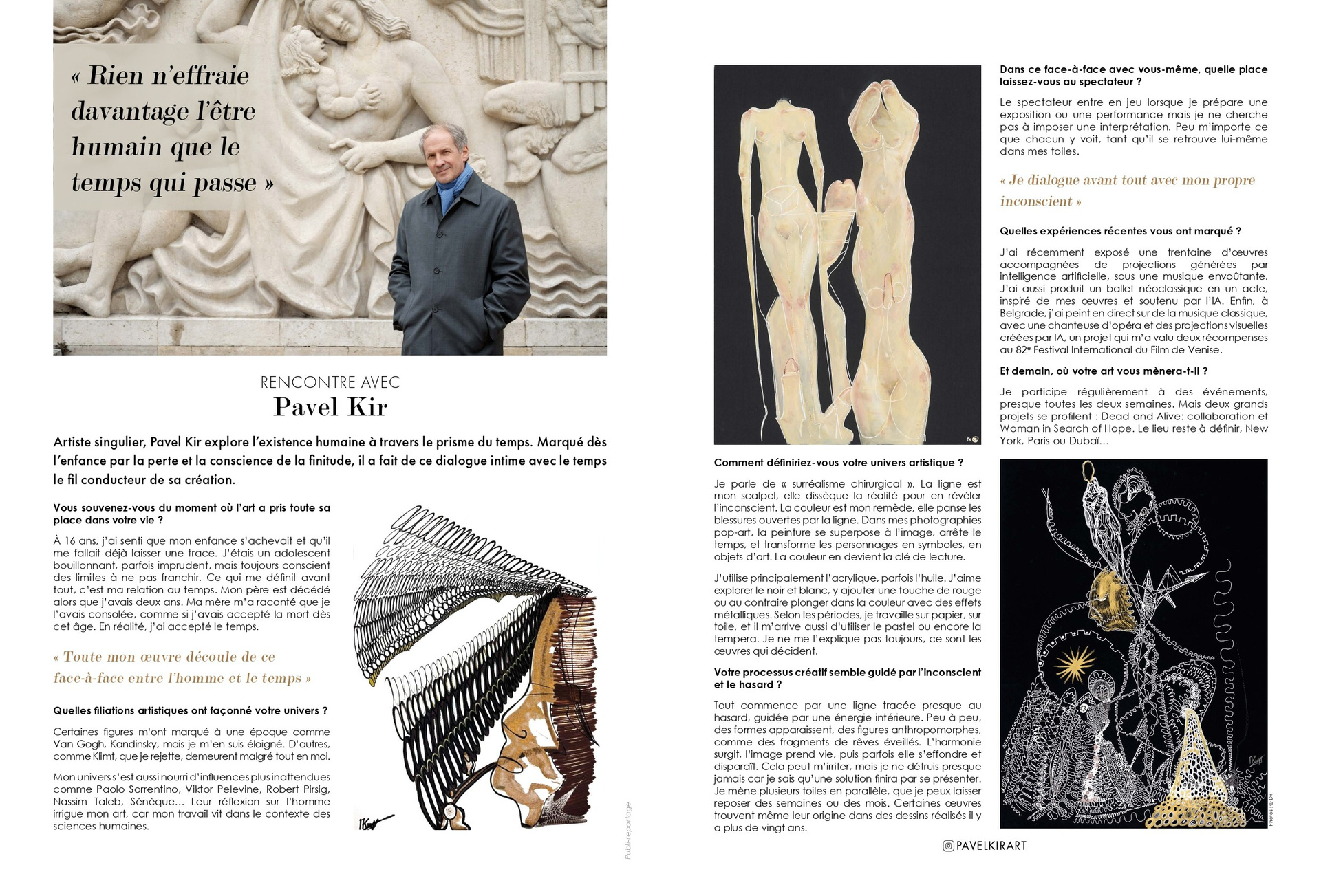
“Nothing frightens human beings more than the passing of time”
October 2025
Do you remember the moment when art fully entered your life?
At 16, I felt that my childhood was ending and that I already had to leave a
trace. I was a passionate, sometimes reckless teenager, yet always aware of
boundaries not to cross. What defines me above all is my relationship with
time. My father died when I was two. My mother told me that I consoled her, as
if I had already accepted death at that age. In reality, I accepted time.
“All my work stems from this confrontation between man and time.”
Which artistic
lineages have shaped your universe?
Some figures influenced me at certain moments, like Van Gogh or Kandinsky, but
I eventually moved away from them. Others, like Klimt–whom I reject–remain
within me nonetheless.
My universe has also been nourished by more unexpected influences such as Paolo
Sorrentino, Viktor Pelevin, Robert Pirsig, Nassim Taleb, Seneca… Their
reflections on humanity flow through my art, because my work lives within the
context of the human sciences.
How would you define your artistic universe?
I call it “surgical surrealism.” The line is my scalpel; it dissects
reality to reveal the unconscious. Color is my remedy; it heals the wounds
opened by the line.
In my pop-art photographs, paint overlaps the image, stops time, and transforms
people into symbols, into objects of art. Color becomes the key to
interpretation.
I mainly use acrylic, sometimes oil. I love exploring black and white, adding a touch of red, or immersing myself in color with metallic effects. Depending on the period, I work on paper, on canvas, and sometimes with pastel or tempera. I can’t always explain it — the works decide.
Your creative process seems guided by the unconscious and by chance?
It all begins with a line, drawn almost by chance, guided by an inner energy.
Little by little, forms emerge — anthropomorphic figures, fragments of waking
dreams. Harmony appears, the image comes alive, then sometimes collapses and
vanishes. That can irritate me, but I almost never destroy, because I know a
solution will eventually reveal itself.
I work on several canvases in parallel, leaving them to rest for weeks or
months. Some works even originate from drawings made more than twenty years
ago.
In this face-to-face with yourself, what space do you leave for the viewer?
The viewer comes into play when I prepare an exhibition or a performance, but I never try to impose an interpretation. It doesn’t matter what one sees, as long as they find themselves in my paintings.
“I am first and foremost in dialogue with my own unconscious.”
Which recent experiences have marked you?
I recently exhibited about thirty works accompanied by AI-generated projections, under enchanting music. I also produced a one-act neoclassical ballet inspired by my works and supported by AI. Finally, in Belgrade, I painted live to classical music, alongside an opera singer and AI-generated visuals — a project that earned me two awards at the 82nd Venice International Film Festival.
And tomorrow, where will your art lead you?
I regularly participate in events, almost every two weeks. But two major projects are on the horizon: Dead and Alive: Collaboration and Woman in Search of Hope. The location is still to be defined — New York, Paris, or Dubai…